

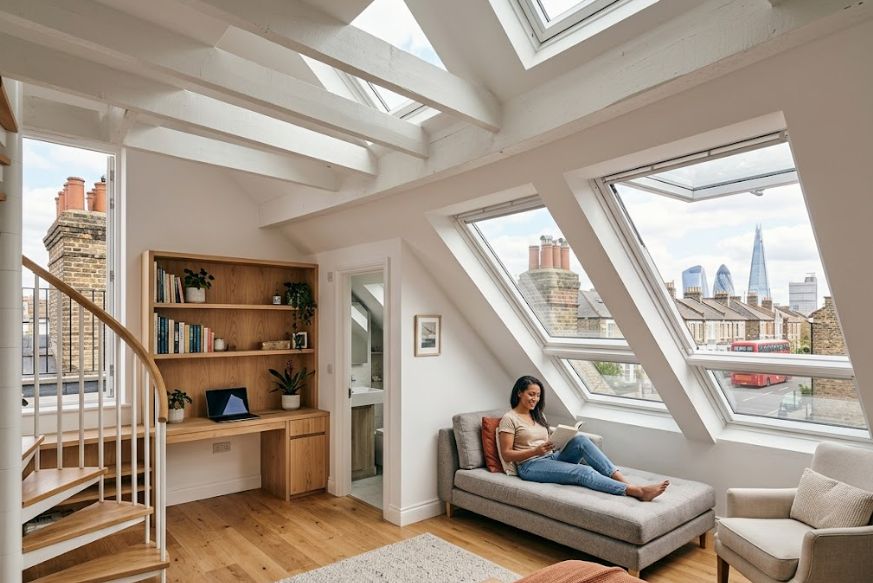
A loft conversion is widely regarded as the single most cost-effective home improvement available to London homeowners. Unlike a house extension, which requires planning permission, significant garden space, and complex groundwork, most loft conversions can be completed within Permitted Development Rights, require no sacrifice of garden space whatsoever, and deliver a new, fully functional room, or suite of rooms, at a cost that consistently represents outstanding value relative to the additional floor space and property value created.
The typical London loft conversion adds between one and three rooms to a property: a master bedroom suite with en-suite bathroom is the most popular configuration, transforming a three-bedroom terrace house into a four-bedroom home with en-suite and dramatically increasing its market value and desirability.
Home offices, children’s bedrooms, hobby rooms, and media rooms are equally common. Whatever your specific requirements, a professionally designed and built loft conversion can almost certainly deliver the additional space you need without the disruption and cost of moving house.
MayfairMarketplace.uk connects London homeowners with specialist loft conversion builders who combine structural expertise, design sensitivity, and meticulous project management to deliver outstanding results on time and within budget.
Types of Loft Conversion Available in London
Velux / Rooflight Loft Conversions
The simplest and most cost-effective loft conversion type. Rather than altering the external shape of the roof, a Velux conversion installs roof windows (skylights) into the existing roof slope to bring light and ventilation into the converted space.
Because the external roof structure is unchanged, Velux conversions almost always fall within Permitted Development Rights and do not require planning permission. They are ideal for loft spaces with sufficient existing headroom, typically a minimum of 2.2 metres from floor to ridge.
Dormer Loft Conversions
The most popular loft conversion type across London. A dormer extends outward from the existing roof slope, creating a vertical-sided structure with a flat roof that substantially increases both the headroom and the usable floor area within the loft. Rear dormers are typically permitted under Permitted Development Rights for terraced and semi-detached houses. A large rear dormer can transform even a relatively modest loft space into a full, properly proportioned bedroom with en-suite.
L-Shaped Dormer Conversions
Unique to Victorian and Edwardian terrace houses with a rear outrigger (back addition), the L-shaped dormer extends across both the main rear roof slope and the outrigger roof slope simultaneously, creating an L-shaped dormer structure that delivers exceptional floor space, often sufficient for two full rooms plus a bathroom.
Hip-to-Gable Conversions
Properties with a hipped roof, where the roof slopes on all four sides have a significantly reduced usable loft space compared to properties with a standard gable end. A hip-to-gable conversion extends the existing roof by replacing the sloping hip with a vertical gable end wall, dramatically increasing the usable floor area. Hip-to-gable conversions are frequently combined with a rear dormer for maximum space gain.
Mansard Conversions
The most premium and most dramatically space-creating loft conversion type. A mansard conversion involves completely restructuring the rear roof slope, replacing it with a near-vertical wall (typically at 72 degrees) topped with a shallow flat roof. Mansard conversions require planning permission but deliver the maximum possible headroom and floor area from any loft space and are particularly popular in conservation areas and with Victorian terrace houses across London.
The Loft Conversion Process
A professional loft conversion project, managed by our listed London specialists, follows a clearly structured process:
1. Feasibility Assessment
Your loft conversion specialist will visit your property to assess the existing loft space, measure the available headroom, evaluate the roof structure, and confirm which conversion types are technically feasible for your specific property.
2. Architectural Design
A set of detailed architectural drawings is produced, showing the proposed layout, stair position, window locations, and room configurations. These drawings form the basis of any planning application and the Building Regulations submission.
3. Structural Engineering
A structural engineer calculates the required steel beam sizes, purlin positions, and floor joist specifications to support the new loft structure safely. These calculations are submitted as part of the Building Regulations application.
4. Construction
A typical loft conversion takes between six and ten weeks to complete from scaffold erection to final fit-out and decoration. The majority of the structural work is completed from scaffold externally, meaning the disruption to your daily life inside the house is minimised.
Frequently Asked Questions
Consistently yes. A well-executed loft conversion adding a bedroom and bathroom to a London property typically increases market value by between 15% and 25%, making it one of the highest-return home improvements available. In many parts of London, the additional value created significantly exceeds the cost of the conversion.
Most dormer and Velux loft conversions on standard London terrace and semi-detached houses fall within Permitted Development Rights and do not require formal planning permission. However, properties in Conservation Areas, Article 4 Direction areas, or that are Listed Buildings will require planning consent. Mansard conversions always require planning permission. Your specialist will confirm your specific position during the feasibility assessment.
Yes, in almost all cases. The majority of the structural loft conversion work is completed externally from scaffolding, and the new staircase is typically installed in a single intensive day. Most families experience only minimal disruption to daily life during the construction period.
Start Your Loft Conversion Project Today
Transform your unused loft space into the room your family has always needed. Use MayfairMarketplace.uk to find a trusted, specialist loft conversion builder in your London borough. Submit your enquiry today for a free, no-obligation feasibility assessment and quotation.