

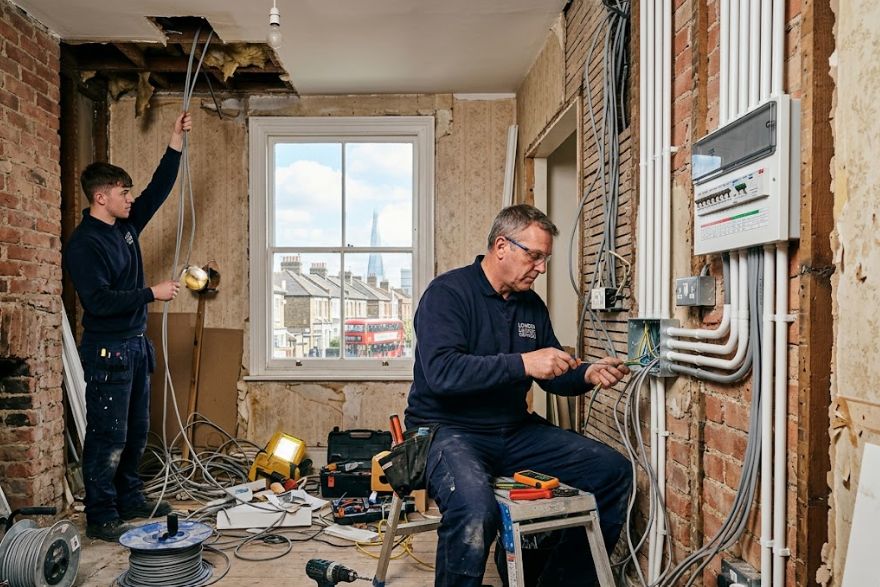
The electrical wiring installed in many of London’s period properties the Victorian terraces of Hackney and Islington, the Edwardian semis of Ealing and Finchley, the inter-war houses of Bromley and Croydon is frequently decades old and has long since reached the end of its safe working life. Rubber-insulated wiring from the 1950s and 1960s becomes brittle and cracks over time, exposing live conductors.
Aluminium wiring used in some properties during the 1970s degrades at connection points and presents a serious fire risk. Old two-core wiring without an earth conductor leaves appliances and individuals unprotected against fault currents.
A full house rewire, carried out by a qualified, NICEIC or NAPIT-registered electrician, is the only safe and permanent solution to fundamentally outdated or deteriorated wiring. Whilst the prospect of a full rewire may seem disruptive, the process is well-managed by experienced professionals and, in most cases, does not require a family to vacate the property for the duration of the works.
MayfairMarketplace.uk connects London homeowners, landlords, and property developers with experienced rewiring specialists who combine technical excellence with thoughtful, minimal-disruption working practices.
Signs Your London Property May Need Rewiring
Many London homeowners are unaware that their property’s wiring is potentially unsafe until a problem manifests. Key warning signs that may indicate the need for a rewire include:
- Visible rubber or fabric-covered wiring: If you can see wiring in your loft, under floorboards, or inside junction boxes that is covered with rubber insulation (often cracked or disintegrating) or fabric braiding, this is old wiring that requires replacement.
- Persistent tripping of circuit breakers: Circuit breakers that trip repeatedly without obvious cause may indicate deteriorating wiring that is causing nuisance faults.
- Burning smells or scorch marks near sockets, switches, or the consumer unit, which may indicate overheating caused by poor connections in deteriorating wiring.
- Two-pin, round-pin sockets: A clear indicator of a very old electrical installation that requires complete replacement.
- No RCD protection: On lighting or socket circuits a significant safety deficiency that an EICR will identify as a C2 code.
- Frequent light bulb failures: It can indicate voltage fluctuations associated with deteriorating wiring connections.
What Does a Full House Rewire Involve?
A full house rewire involves the complete replacement of all fixed wiring within the property, from the incoming consumer unit through to every socket, switch, light fitting, and fixed appliance connection. The process, carried out by an experienced team of London electricians, typically follows this sequence:
1. First Fix
Electricians run all new cable routes throughout the property, typically through ceiling voids, wall chases, under floorboards, and through new surface-mounted trunking where concealed routes are not practicable. All new back boxes for sockets and switches are installed. Cable routes are agreed with the homeowner at the start of the project to minimise unnecessary disruption.
2. Consumer Unit Installation
A new, fully compliant 18th Edition consumer unit (fuse board) is installed in an appropriate location, incorporating all required RCD protection, RCBO circuit protection, and surge protection devices required under current BS 7671 regulations.
3. Plastering and Making Good
Where wall chases have been cut to run concealed cables, these are filled and plastered flush by a skilled plasterer. Floorboards that were lifted to run cables beneath are re-fixed. This phase of work returns the fabric of the property to its pre-works condition.
4. Second Fix
All sockets, switches, light fittings, and accessories are fitted and connected. All circuits are tested using specialist test equipment to confirm continuity, insulation resistance, polarity, and earth fault loop impedance.
5. Inspection and Certification
A qualified supervisor carries out a full inspection of the completed installation, and an Electrical Installation Certificate (EIC) — the Building Regulations compliance certificate for new electrical work is issued. This document confirms that the completed rewire fully complies with the current edition of BS 7671.
How Long Does a Rewire Take in London?
The duration of a rewire depends on the size of the property and the number of circuits and outlets specified:
- A one or two-bedroom flat: typically three to five working days.
- A three-bedroom house: typically five to eight working days.
- A four or five-bedroom house: typically eight to twelve working days.
- A large period house undergoing comprehensive renovation: may take two to three weeks.
Frequently Asked Questions
For most properties, it is possible to remain living in the house during a rewire, though there will be periods each day when power to sections of the property is isolated. Many homeowners choose to remain in the property and manage the temporary inconvenience, while others prefer to arrange temporary accommodation, particularly if young children are in the household.
Rewire costs in London are higher than the national average due to higher labour rates and the frequently more complex construction of period properties. As a broad guide: a one-bedroom flat from approximately £3,000; a three-bedroom terrace house from approximately £5,500 to £7,500; a four or five-bedroom house from approximately £8,000 to £12,000 or more depending on specification and accessibility. Obtain a minimum of three detailed quotations from registered electricians.
Yes. All new electrical installation work in England and Wales must comply with Building Regulations Part P, and a full house rewire must either be notified to your local authority building control department or carried out by a self-certifying registered competent person scheme member (such as an NICEIC or NAPIT Approved Contractor). Your electrician will issue an Electrical Installation Certificate upon completion.
Book Your London House Rewire Today
Do not put the safety of your family, your tenants, or your property at risk with outdated wiring. Use MayfairMarketplace.uk to find a qualified, experienced rewiring electrician in your London borough. Submit your enquiry today for a thorough site survey and detailed quotation.