

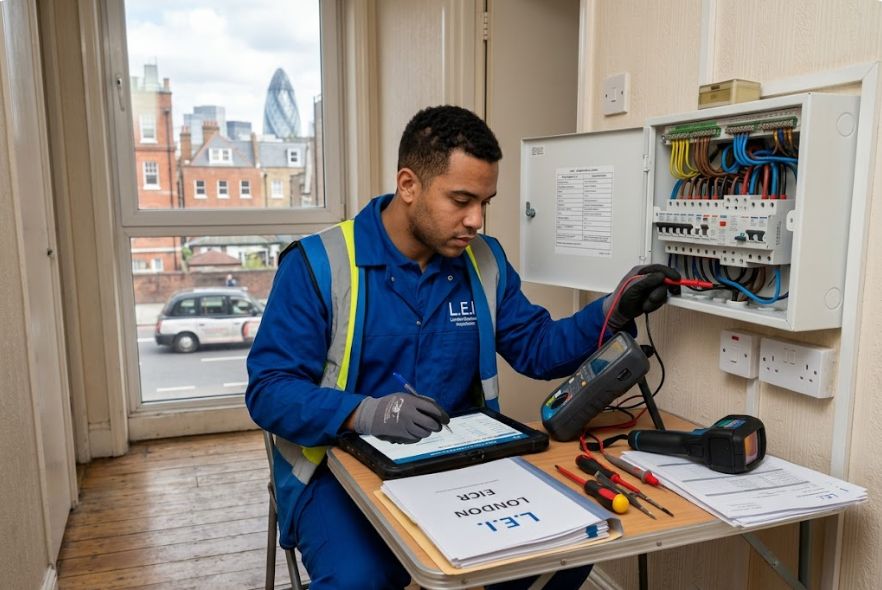
An Electrical Installation Condition Report universally known as an EICR is a formal, written assessment of the safety and condition of all fixed electrical installations within a property. This includes the consumer unit (fuse board), wiring, sockets, switches, light fittings, and all other fixed electrical components. Carried out by a qualified and registered electrician, an EICR identifies any defects, deterioration, damage, or non-compliance with current electrical safety standards (BS 7671 the IET Wiring Regulations) that could pose a risk of electric shock, electrical fire, or equipment damage.
For London landlords, an EICR is not optional it is a legal requirement. The Electrical Safety Standards in the Private Rented Sector (England) Regulations 2020 mandate that all private landlords must have a valid EICR carried out by a qualified person at least every five years, and must provide a copy of the report to their tenants. Non-compliance carries civil penalty fines of up to £30,000 per breach and can expose landlords to significant legal liability in the event of an electrical incident at the property.
MayfairMarketplace.uk connects landlords, homeowners, and businesses across all London boroughs with qualified, Part P-registered electricians who carry out thorough, reliable, and fully certified EICR inspections to the highest professional standards.
Who Needs an EICR in London?
Private Landlords
As noted above, the 2020 Regulations make EICR certification a strict legal requirement for all private residential landlords in England. The report must be no more than five years old, must be issued by a qualified electrician, and a copy must be provided to all existing tenants within 28 days of the inspection and to any new tenants before they occupy the property.
Homeowners
Whilst homeowners are not legally required to obtain an EICR, it is strongly recommended when purchasing an older property, following any period of extended vacancy, after any significant flooding or water ingress, or when undertaking a major renovation. An EICR gives you a comprehensive, independent assessment of the condition of the property’s electrical installation and identifies any remedial work required before it becomes a safety issue.
Commercial Property Owners and Businesses
Under the Electricity at Work Regulations 1989, employers and duty holders have a legal obligation to maintain electrical installations in a safe condition. For commercial premises in London, an EICR is the standard method of demonstrating compliance with this duty. Commercial EICRs are typically recommended every three to five years for most business premises, and every one to three years for higher-risk environments such as industrial premises, swimming pools, and catering kitchens.
Mortgage Applications and Property Purchases
Mortgage lenders and conveyancing solicitors increasingly request a valid EICR as part of the property purchase due diligence process, particularly for older properties. Having a current EICR in place can significantly smooth the mortgage and conveyancing process.
What Does an EICR Inspection Involve?
A thorough EICR inspection is a detailed, methodical process that takes between two and four hours for a typical London domestic property, and longer for larger or more complex commercial premises.
Your qualified electrician will:
- Visually inspect the consumer unit (fuse board), checking for signs of overheating, incorrect fuse ratings, outdated circuit breaker types, and the presence or absence of a Residual Current Device (RCD).
- Carry out dead testing of circuits using specialist test equipment to verify circuit continuity, insulation resistance, polarity, and earth fault loop impedance measurements.
- Carry out live testing to verify the correct operation of RCDs and other protective devices.
- Inspect accessible wiring, sockets, switches, and light fittings throughout the property for signs of damage, overheating, incorrect installation, or deterioration.
- Issue a formal written report detailing the condition of all inspected elements, coded according to the severity of any defects identified.
Understanding EICR Codes
The EICR report categorises any defects or observations identified during the inspection using a standardised coding system:
- C1 (Danger Present): An immediate risk of injury. Requires urgent remediation before the installation can be considered safe for continued use.
- C2 (Potentially Dangerous): Not an immediate danger, but a significant risk that requires remediation as soon as possible.
- C3 (Improvement Recommended): Not a safety risk per se, but an improvement to current standards is recommended. A C3 observation does not prevent the report from being classified as Satisfactory.
- FI (Further Investigation Required): An issue has been identified that requires further investigation to determine its extent or severity.
A report containing any C1 or C2 codes is classified as Unsatisfactory, meaning remedial electrical work must be carried out and a new EICR issued before the installation can be considered compliant. A report containing only C3 observations or no defects at all is classified as Satisfactory.
How Much Does an EICR Cost in London?
EICR prices in London vary according to the size of the property, the number of circuits, and the accessibility of the installation. As a general guide:
- A one or two-bedroom flat: typically £150 to £250.
- A three or four-bedroom house: typically £200 to £350.
- A five or six-bedroom house: typically £300 to £450.
- Commercial premises: priced individually based on size and complexity.
Always ensure your quoted price includes the full written report and not just the inspection visit. Avoid very low-priced quotes, as a thorough EICR inspection cannot be completed properly in under two hours for a standard London property.
Frequently Asked Questions
For private rented properties, an EICR is valid for a maximum of five years. For owner-occupied homes, the recommended re-inspection period is ten years. For commercial premises, the frequency is determined by the nature of the premises and specified in the report itself.
If your EICR is classified as Unsatisfactory due to C1 or C2 defects, the identified remedial works must be carried out by a qualified electrician and a completion certificate issued. For landlords, the 2020 Regulations require this remedial work to be completed within 28 days of the inspection (or sooner if specified for C1 defects). A new EICR must then be obtained to confirm the installation is now satisfactory.
Yes. There is no requirement for the remedial works to be carried out by a different electrician. Using the same qualified electrician who carried out the inspection is often the most efficient approach, as they have already identified the specific defects and understand the extent of the work required.
Book Your EICR in London Today
Do not expose yourself, your tenants, or your business to the serious legal and safety risks of an uncertified electrical installation. Use MayfairMarketplace.uk to find a qualified, registered EICR electrician in your London borough. Submit your enquiry today for a fast, reliable, and fully certified electrical inspection.