

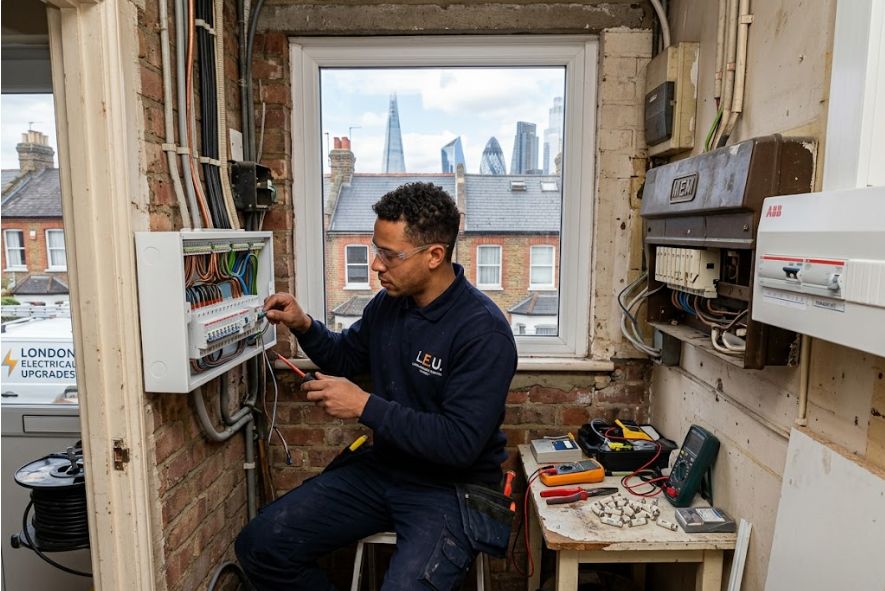
The consumer unit commonly referred to as the fuse board or fuse box is the nerve centre of your property’s entire electrical installation. It is the point at which the incoming electricity supply is divided into individual circuits, each protected by a circuit breaker or fuse that will automatically interrupt the supply if a fault occurs on that circuit. It is also where the critical safety devices that protect you from electric shock Residual Current Devices (RCDs) are installed. The condition, specification, and compliance of your consumer unit has a direct and significant impact on the safety of your entire electrical installation.
Many London properties particularly older Victorian, Edwardian, and mid-twentieth-century houses and flats still have consumer units that are seriously outdated and non-compliant with current electrical safety standards. Old rewirable fuse carriers (where a length of fuse wire is the only overcurrent protection), obsolete circuit breakers with inadequate fault current ratings, and older plastic-cased consumer units without adequate RCD protection all present risks that a modern, compliant consumer unit upgrade eliminates entirely.
MayfairMarketplace.uk connects London homeowners, landlords, and businesses with qualified NICEIC and NAPIT-registered electricians who carry out thorough, fully compliant consumer unit upgrades to the 18th Edition of BS 7671 (the IET Wiring Regulations).
Signs That Your Consumer Unit Needs Upgrading
Old Rewirable Fuse Carriers
If your consumer unit contains ceramic fuse carriers with exposed fuse wire rather than modern miniature circuit breakers (MCBs), your electrical installation is seriously outdated. Rewirable fuses offer very limited overcurrent protection compared to modern MCBs, are frequently incorrectly rewired with the wrong fuse wire rating, and provide no RCD protection whatsoever.
Plastic-Cased Consumer Units
The 18th Edition of BS 7671, which came into effect in January 2019, requires all new and replacement consumer units in domestic premises to be housed in a non-combustible enclosure, typically a metal case. Older plastic-cased consumer units do not meet this requirement and must be replaced when a consumer unit upgrade is carried out.
No RCD Protection
RCDs protect against electric shock by detecting very small earth fault currents and cutting the supply within milliseconds — fast enough to prevent a fatal shock in most circumstances. Older consumer units frequently lack adequate RCD protection on all circuits. An EICR will identify the absence of RCD protection as a C2 code deficiency.
Insufficient Circuits
Many older consumer units simply do not have enough circuits to meet the electrical demands of a modern home. A property where all upstairs lighting is on a single circuit, or where the kitchen has only one socket circuit, requires additional circuits to be added, which typically necessitates a full consumer unit replacement to accommodate the additional circuit breakers.
Frequent Unexplained Tripping
An older consumer unit where circuit breakers trip regularly without clear cause may have circuit breakers with degraded trip mechanisms that are no longer operating correctly, or may have RCDs that are overly sensitive to normal leakage currents from modern appliances. A replacement unit resolves both issues.
What Is Included in a Consumer Unit Upgrade?
A consumer unit upgrade carried out by our listed London electricians includes:
- Removal and safe disposal of the existing consumer unit and all associated main tails, earthing, and bonding conductors.
- Supply and installation of a new, fully compliant metal-clad 18th Edition consumer unit, incorporating dual RCD or RCBO protection on all circuits, surge protection devices (SPDs) as required, and all required circuit breakers at appropriate ratings for each circuit.
- Replacement of the main earthing conductor and all main equipotential bonding conductors to current standard.
- Testing of all existing circuits connected to the new unit to verify their condition.
- Issue of an Electrical Installation Certificate confirming full compliance with BS 7671 and Building Regulations Part P.
- Notification to your local authority building control (or self-certification through a registered competent person scheme) as required by Building Regulations.
How Long Does a Consumer Unit Upgrade Take?
A straightforward consumer unit replacement on a standard London domestic property is typically completed within a single working day usually between four and eight hours, depending on the number of circuits and the accessibility of the existing installation. The property’s electrical supply will be isolated for the duration of the installation, so it is advisable to plan around this interruption.
Consumer Unit Upgrades for Landlords
For London landlords, a consumer unit upgrade is frequently identified as a required C2 remedial action following an EICR inspection. The 2020 Electrical Safety Regulations require landlords to complete all C1 and C2 remedial works within 28 days of the inspection. Given that an outdated consumer unit is one of the most commonly identified C2 deficiencies on older London rental properties, many landlords arrange a consumer unit upgrade proactively — before an EICR is conducted — to minimise the risk of a Unsatisfactory EICR result and the associated remedial work obligations.
Frequently Asked Questions
Yes, in many cases. A number of home insurance providers ask about the age and specification of the consumer unit as part of their risk assessment process, and some will reduce premiums or decline to offer certain covers for properties with seriously outdated electrical installations. A modern, compliant consumer unit can improve your insurance position and demonstrates responsible property stewardship.
Yes. A consumer unit replacement is notifiable work under Part P of the Building Regulations. Your electrician must either notify the work to your local authority building control department before commencing, or must be a registered member of a Part P competent person scheme (such as NICEIC or NAPIT) that allows them to self-certify the work upon completion.
Yes, and this is often the most efficient approach. If your electrician carries out the EICR and identifies that a consumer unit upgrade is required as a remedial action, they can carry out the upgrade immediately or at a closely scheduled follow-up appointment, issuing both the remedial EICR and the Electrical Installation Certificate for the new consumer unit upon completion.
Upgrade Your Consumer Unit Today
Protect your home, your family, your tenants, and your property with a modern, fully compliant consumer unit. Use MayfairMarketplace.uk to find a qualified, registered electrician in your London borough who can survey your existing installation and provide a detailed quotation for a compliant consumer unit upgrade.